
Home > Grinding Mills > Vertical Sand Mills
vertical sand mill
VERTICAL SAND MILL
The New Vertical Sand Mill
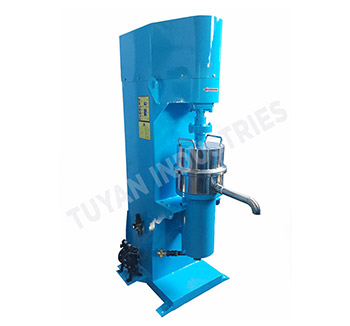
The vertical sand mill provides an efficient solution for demanding industrial grinding processes. Engineers designed this mill to achieve uniform particle size and high-quality dispersion. They chose the vertical design to eliminate mechanical seals, which reduces maintenance and prevents leakage during operation. Additionally, the mill features a durable polyurethane (PU) elastomer lining that protects the internal chamber. PU offers excellent abrasion resistance, extending the machine’s service life.
Compared to ball mills and other traditional systems, the vertical sand mill delivers higher energy density, grinding materials faster and more efficiently. Moreover, it includes an advanced media separation system at both the feed and discharge points. This system uses centrifugal force to keep grinding media away from the slurry. The separation unit sits atop the agitator, ensuring smooth flow throughout the process.
Operators can easily add grinding media through the central feeding system, supporting continuous operation and consistent product quality. As a result, the mill improves efficiency, lowers downtime, and reduces operating costs for industries.
Advantages of the Vertical Sand Mill
The Vertical Sand Mill offers a significant advantage with its simplified operating system. It contains very few wear parts, including the agitator discs, chamber lining, and separation components. The media feeding system is straightforward and easy to control, which helps prevent unnecessary wear inside the mill. Additionally, the air pump feeds media smoothly, reducing maintenance costs, and the tubes are low-cost and quick to replace.
Many vertical mills operate successfully in ceramic plants, grinding SiC using SiC grains as media. These mills deliver impressive wear life that exceeds 2,000 hours, even in highly abrasive applications. The mill also supports full automation with sensors for flow, temperature, and pressure, allowing continuous operation without an operator. This ensures consistent product quality, stable production, and improved efficiency while lowering downtime and operating costs for industries.